Vented vs. closed crawl spaces in North Carolina
For decades crawl spaces were built with vents so they could breathe. In a humid climate that lets moisture in. North Carolina is one of the places where the closed crawl space was studied in real houses and written into code.
Why crawl spaces were vented
The idea behind foundation vents is simple: let outdoor air move through the crawl space so moisture rising from the soil is carried away before it can build up. Building codes adopted the approach decades ago, with rules for how much vent area a crawl space needs for its size, and most houses in the Triangle built before the 2000s, and many built since, have a row of vents around the foundation.
In a cold, dry climate, venting works reasonably well. The outdoor air is drier than the crawl space air, so ventilation removes moisture.
Why vents backfire in a humid climate
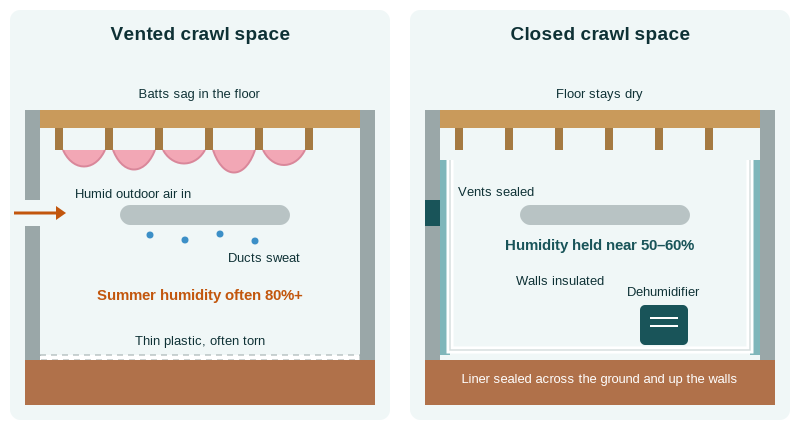
North Carolina summers turn that logic around. Outdoor air from June through September is warm and humid, with dew points often around 70 degrees. The crawl space, shaded and against the cool earth, is several degrees cooler. When the outdoor air flows in and cools, its relative humidity rises, frequently into the 80s and 90s, and moisture condenses on the coldest surfaces: air conditioning ducts, cold water pipes and the underside of an air-conditioned floor.
So in the season when venting is supposed to help, it is the main source of moisture. That is why sweating ducts, mildewed joists, falling insulation and musty smells cluster in late summer, and why opening the vents wider makes things worse.
How a closed crawl space works
A closed crawl space, also called a sealed, unvented or encapsulated crawl space, stops both the ground moisture and the humid outdoor air:
- A continuous liner covers the soil and runs up the foundation walls, with seams lapped and sealed.
- Foundation vents and other openings are sealed, and a tight access door is installed.
- Insulation moves from the floor to the foundation walls and rim joist.
- The small amount of moisture still getting in is removed by a dehumidifier or a modest supply of conditioned air from the house’s HVAC system.
The crawl space becomes, in effect, part of the house: cool and dry in summer, closer to indoor temperature in winter. See crawl space encapsulation for how the work is done.
North Carolina research and code
North Carolina played an outsized role in proving closed crawl spaces work. Advanced Energy, a nonprofit based in Raleigh, ran field studies comparing closed and vented crawl spaces in occupied houses. The closed crawl spaces stayed considerably drier through the humid months, and the houses above them generally used less energy for heating and cooling.
North Carolina’s residential code includes provisions for closed crawl spaces. In broad terms they cover the ground vapor retarder and how it is lapped and sealed, sealing the vents and openings, how the walls are insulated, and an approved way to remove moisture from the space. Because North Carolina has heavy termite pressure, insulated foundation walls also need an inspection gap at the top so termite activity can be seen. Any contractor closing a crawl space should know the current requirements and build to them.
What to check before closing a crawl space
Closing a crawl space changes how it works, so a few things have to be dealt with first:
- Liquid water. Standing water or chronically wet soil needs drainage before sealing. See crawl space waterproofing.
- Combustion appliances. A gas furnace or water heater that draws combustion air from the crawl space needs another air supply or a sealed-combustion replacement, arranged by a licensed contractor.
- Dryer vents and bath fans that empty into the crawl space must be extended outdoors.
- Termites. Active infestations are treated by a licensed pest control company before the space is closed.
- Radon. A sealed crawl space can be paired with radon mitigation if a test shows elevated levels.
Which one is right for your house
A vented crawl space can be acceptable where readings stay moderate in summer, there is no ductwork in the space and the ground cover is intact. For most Triangle houses, especially those with ducts or an air handler under the floor, a closed crawl space is the more reliable way to keep the framing dry and the house comfortable. The encapsulation vs. vapor barrier guide compares the in-between option, and a crawl space inspection shows which one your readings support.
Myths about closing crawl spaces
“A house needs to breathe.” Fresh air for the people in a house comes through the living space and the HVAC system, not up through the floor. A crawl space breathing humid outdoor air is a moisture source, not a ventilation system.
“Sealing a crawl space causes mold.” Closing vents without a ground liner or any way to remove moisture can trap humidity. A complete closed crawl space, with a liner, sealed openings and a dehumidifier or conditioned air, stays drier than a vented one.
“Closing the vents in winter is enough.” Winter is the season vents do the least harm. Closing them in winter and opening them in summer has it backward in this climate.
“Closing it will trap radon.” Soil gases enter crawl spaces either way. A sealed liner reduces how much gets in, and if a test shows elevated radon, a mitigation system can be built into the encapsulation.
Vented vs. closed crawl spaces — common questions
Are closed crawl spaces allowed in North Carolina?
Yes. The North Carolina Residential Code includes requirements for closed crawl spaces, covering the ground liner, sealed openings and a way to remove moisture.
Is it bad to close crawl space vents?
Closing vents alone, over bare soil and without moisture removal, can trap moisture. Closing them as part of a complete closed crawl space is the approach research favors in humid climates.
Who studied closed crawl spaces in North Carolina?
Much of the field research was done by Advanced Energy, a Raleigh-based nonprofit, which compared closed and vented crawl spaces in real houses and found the closed ones stayed considerably drier.
Does closing a crawl space need a permit?
It depends on the town and the scope. Work that adds electrical or mechanical equipment, changes an appliance's air supply or involves structural repairs may need permits, and the contractor should know what applies.
More crawl space guides
Want someone to look under your house?
Call and describe what you are seeing or smelling, or send the details and we will follow up.