Floor joist repair in Cary, NC
Sagging, bouncy or sloping floors fixed from below: cracked or rotted joists sistered, new steel support posts on proper footings, and damaged sill plates and girders replaced.
- Cracked, notched or rotted joists sistered
- Adjustable steel support posts on new footings
- Girders and beams added or replaced
- Rotted sill plates and rim joists replaced
- Permits and engineering when the job calls for it
Covering Cary · Apex · Holly Springs · Morrisville · Raleigh
Book floor joist repair
Readings, not guesses
Inspections record humidity and wood moisture readings, with photos of what is under the house, so you can see the problem yourself.
The cause fixed first
Water and humid air are stopped before anything is sealed, so a new liner never hides a problem that keeps going.
A written, itemized price
Every part of the job is listed and priced in writing before work starts, so you can choose what to do now and what can wait.
Why choose us
A dry crawl space and a healthier house above it
Air from the crawl space rises into the rooms above it. Keeping that space dry protects the framing, the ductwork and the air you breathe.
- Moisture and wood readings
- Photos of every finding
- Written, itemized quotes
- Closed crawl spaces built to code
- Closing and inspection deadlines
- Local to Cary
Signs of a floor framing problem
Floor framing problems rarely announce themselves all at once. The signs build over years:
- A dip or slope you can feel walking across a room, often near the middle of the house
- Floors that bounce when someone walks by, rattling dishes in a cabinet
- Doors that stick, swing open on their own or no longer latch
- Diagonal cracks at the corners of doors and windows, or cracks in floor tile
- Gaps opening between baseboards and the floor
Any of these is worth a look from underneath, where the cause is usually visible.
How a floor over a crawl space is held up
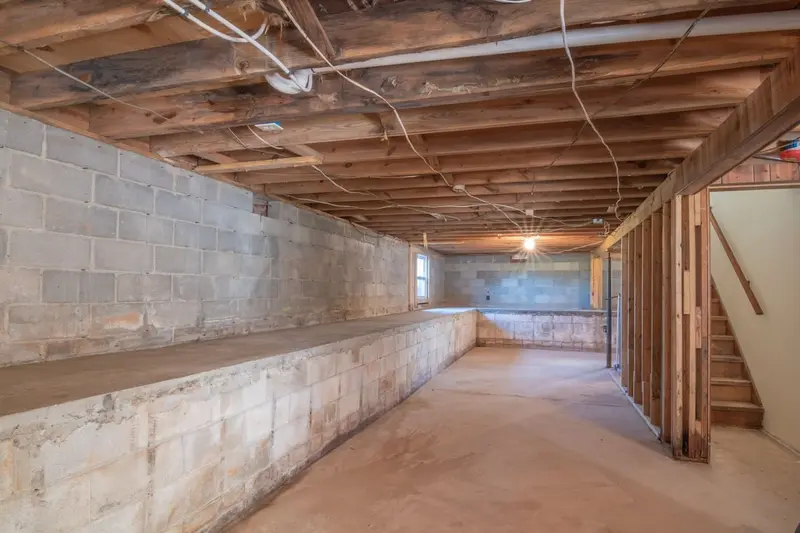
A floor over a crawl space is a simple structure. Floor joists, usually two-by-eights, two-by-tens or engineered I-joists, span from the foundation walls to one or more girders, heavy beams that run the length of the house. The girders rest on piers, typically brick or concrete block columns, which sit on concrete footings in the soil. Around the edge, the joists sit on a sill plate bolted to the top of the foundation wall, capped by a rim joist.
When any part of that chain is undersized, damaged or settling, the floor above shows it.
Common causes of sagging and bouncy floors
- Long spans. Joists or girders spanning farther than their size allows deflect under load, which feels like bounce.
- Too few piers. Girders with supports spaced too far apart sag between them.
- Settled piers and footings. Footings on soft or wet soil sink, taking the girder down with them. Clay that swells and shrinks with moisture makes this worse.
- Cut and notched joists. Plumbers and HVAC installers sometimes cut through joists to run pipes and ducts, removing much of their strength.
- Moisture and rot. Years of damp air or a leak weaken wood, especially at the sill plate and the ends of joists. See wood rot.
- Termites. Eastern subterranean termites, common across North Carolina, hollow out framing from the inside.
Sistering joists
A cracked, notched or partly rotted joist is usually repaired by sistering: a new joist of the same depth is fastened alongside the damaged one, with construction adhesive and bolts or structural screws, so the two work as one. Sisters can run the full length or extend well past the damaged area on both sides. Where a joist is too far gone, it is cut out and replaced.
Steel support posts and new footings
Where a girder sags between piers, or a pier has settled, new support is added beneath it. The modern standard is an adjustable steel support post set on a new concrete footing sized for the load. The post is tightened gradually to take up the sag, often over several visits, so the finishes upstairs have time to adjust. Stacked blocks and wood shims on bare soil, a common quick fix, settle again and are not a lasting repair.
Rotted sill plates, rim joists and girders
Rot concentrates where water does: under exterior doors and leaky windows, where a deck ledger is attached without flashing, along the side of the house where gutters overflow, and anywhere a plumbing leak has run for years. Damaged sill plates and rim joists are replaced in sections while the framing above is temporarily supported. Rotted or undersized girders can be replaced or supplemented with a new beam.
Permits, engineering and fixing the moisture first
Structural repairs often require a building permit, and larger ones may need a letter or drawings from a structural engineer. Every repair should be paired with fixing the moisture that caused or worsened the damage, through drainage, crawl space encapsulation and mold removal where needed. New lumber in a wet crawl space eventually develops the same problems as the old. A crawl space inspection is the starting point.
Floor joist repair — common questions
Why are my floors sagging?
Common causes are joists that span too far, girders with too few supports beneath them, piers or footings that have settled, joists cut or notched for plumbing and ducts, and wood weakened by long-term moisture or termites.
What is sistering a joist?
Fastening a new joist alongside a damaged one, glued and bolted or nailed, so the pair carries the load together. It is the standard repair for cracked or notched joists.
Are crawl space support jacks a permanent fix?
Adjustable steel support posts set on proper concrete footings are a common permanent repair. Temporary jacks sitting on loose blocks or bare dirt are not, because the base settles.
Can floors be lifted back to level?
Often partly. Floors are raised slowly, a little at a time, so drywall, tile and door frames above are not cracked. Some old sag is permanent and is supported where it is rather than forced level.
Do structural repairs need a permit?
Many do, and some need an engineer's letter. The local building inspections department decides, and the contractor should pull any permit the job needs.
Problems this fixes
Often booked with this