Crawl space encapsulation in Cary, NC
A sealed, dry crawl space: a heavy reinforced liner across the ground and up the walls, vents and gaps sealed, and a dehumidifier holding the humidity down all year.
- Reinforced 12- to 20-mil liner, seams overlapped and taped
- Liner run up the walls and sealed around piers
- Vents and gaps sealed, rim joist insulated
- Dehumidifier with a drain line, set near 55% humidity
- Insulated, gasketed access door
Covering Cary · Apex · Holly Springs · Morrisville · Raleigh

Book crawl space encapsulation
Readings, not guesses
Inspections record humidity and wood moisture readings, with photos of what is under the house, so you can see the problem yourself.
The cause fixed first
Water and humid air are stopped before anything is sealed, so a new liner never hides a problem that keeps going.
A written, itemized price
Every part of the job is listed and priced in writing before work starts, so you can choose what to do now and what can wait.
Why choose us
A dry crawl space and a healthier house above it
Air from the crawl space rises into the rooms above it. Keeping that space dry protects the framing, the ductwork and the air you breathe.
- Moisture and wood readings
- Photos of every finding
- Written, itemized quotes
- Closed crawl spaces built to code
- Closing and inspection deadlines
- Local to Cary
What crawl space encapsulation includes
Encapsulation turns a vented crawl space, open to the outdoors and to the soil, into a closed one that behaves like part of the house. It is not one product but a set of parts that work together:
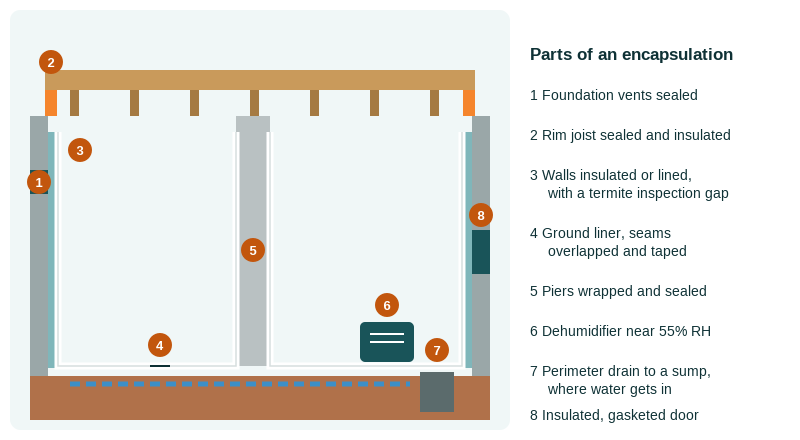
- Foundation vents sealed airtight.
- The rim joist, the band of framing on top of the foundation, sealed and insulated.
- Foundation walls lined or insulated, with a termite inspection gap at the top.
- A heavy liner across the whole floor, seams overlapped and taped.
- Piers wrapped and sealed into the liner.
- A dehumidifier, or conditioned air from the HVAC system, to remove moisture.
- A perimeter drain and sump where liquid water gets in.
- An insulated, gasketed access door.
Leave out any one of these and the system works less well. A liner with the vents still open lets humid air in. Sealed vents without moisture removal trap whatever humidity is left.
The liner: thickness, reinforcement and seams
Liners are measured in mil, thousandths of an inch. Builder-grade ground cover is often 6 mil, the code minimum, and it tears the first time someone crawls across it. Encapsulation liners are usually 10 to 20 mil, with an embedded polyester mesh that stops a puncture from turning into a long tear. Heavier liners cost more but hold up to foot traffic, storage and years of service visits.
The ground is cleared and raked smooth first, and sharp rocks and roots come out. The liner is laid with seams overlapped, commonly by six inches or more, and sealed with tape made for the purpose. It runs up the foundation walls and is fastened with mechanical fasteners and sealant, and each pier is wrapped and taped. The goal is one continuous membrane with no exposed soil anywhere.
Sealing vents, the rim joist and the access door
Foundation vents are closed from the inside with rigid foam cut to fit and sealed in place, or with airtight vent covers. The rim joist, a common source of air leaks, is sealed and insulated with closed-cell spray foam or rigid foam board, and gaps around pipes, wires and the sill are sealed. A flimsy wood hatch is replaced with an insulated, gasketed door. Details are on the vent covers and access doors page.
Drying the air: dehumidifier or conditioned air
Once the space is sealed, the moisture already in the air and the small amount still entering has to be removed. Most encapsulations use a crawl space dehumidifier sized to the space and set to hold relative humidity near 50 to 55 percent, with its condensate drained outside or into a sump. North Carolina’s code also recognizes other ways to dry a closed crawl space, such as a small, continuous supply of conditioned air from the HVAC system, and the right choice depends on the house.
What has to be fixed before sealing
Some conditions have to be dealt with before a crawl space is closed:
- Liquid water. Standing water and wet soil need crawl space waterproofing and often a sump first.
- Gas appliances. A furnace or water heater that draws combustion air from the crawl space needs another air supply, arranged by a licensed contractor.
- Dryer and bath fan vents that empty into the crawl space have to be extended outdoors.
- Termites. Active termites are treated by a licensed pest control company, and the wall insulation leaves the inspection gap the state requires.
North Carolina code and closed crawl spaces
North Carolina was one of the first places closed crawl spaces were studied in real houses, and the state’s residential code includes requirements for them. It sets out what the ground liner, the sealed openings and the moisture removal must include. Any contractor doing this work should know those requirements and build to them. The vented vs. closed crawl spaces guide covers the history and the code in more detail.
How long it takes and what changes afterward
Most encapsulations take one to three days. Humidity in the crawl space usually drops quickly once the dehumidifier is running, and wood moisture follows over the following weeks. Homeowners most often notice the musty smell fading, ducts that no longer drip in summer, and floors that feel warmer in winter. For pricing, the encapsulation cost guide explains what moves the total up or down.
Crawl space encapsulation — common questions
Is crawl space encapsulation worth it?
In a humid climate like the Triangle, usually yes. A sealed crawl space stays drier, protects the framing and ductwork, stops the musty smell that drifts upstairs and often makes the floors above warmer in winter. The payoff is biggest in houses with ductwork in the crawl space.
How long does encapsulation take?
Most crawl spaces take one to three days, depending on size, how much old insulation and debris has to come out, and whether drainage goes in first.
What thickness of liner do I need?
Code sets a 6-mil vapor retarder as the minimum for ground cover. Encapsulation liners are thicker, usually 10 to 20 mil and reinforced with a polyester mesh, so they survive people crawling over them, light storage and the occasional sharp rock.
Will encapsulation stop water from coming in?
No. A liner keeps ground moisture and humid air out, but liquid water from storms or a high water table needs drainage, such as a perimeter drain and a sump pump, installed before or along with the liner.
Can I store things in an encapsulated crawl space?
Yes, that is one of the side benefits. A thick liner holds up to light storage, and the space stays clean and dry.
Problems this fixes
Often booked with this